
Introduction to Academic Art
By Sophia Shen
Academic Art or Academicism is a style of artwork originating from European art academies. Beginning in Italy in the mid-16th century, it became prevalent in the 17th-19th century and peaked after the Napoleonic Wars in 1815. It was notably led by the French Académie des Beaux-Arts, which blended components of Neoclassicism and Romanticism.
These academies often followed strict curricula on how colour, light, and shadow worked together to mimic a real object. Since students learned from the traditional principles set by European academies, it often led to a lack of individual creativity and self-expression. They focused on literary, mythological and historical themes, often creating an idealized depiction of the subject. For example, subjects tended to have perfectly smooth skin, mimicking a marble-like finish. Themes like love, virtue and heroism often promoted a noble narrative, which significantly contributed to French culture at the time. Several prominent painters include William-Adolphe Bouguereau, Alexandre Cabanel, and Paul Delaroche.
William-Adolphe Bouguereau
William-Adolphe Bouguereau, born on November 30th, 1825, in La Rochelle, France, was a French academic painter, known for his realistic depictions of mythological and religious figures, such as those of goddesses, nymphs, shepherdesses and madonnas. His most famous works include The Birth of Venus (1879) and The Bohemian (1890). During his career, he dominated the French art world’s official Salons and established himself as the leading figure in Academic Art.

Fig. 1. Self-Portrait, by William-Adolphe Bouguereau, 1875. Musée d’Orsay, Paris. https://www.musee-orsay.fr/en/collections
In 1846, he entered the École des Beaux-Arts in Paris under the instruction of François-Édouard Picot, where he learned the fundamentals that helped him develop his signature style. After three attempts, Bouguereau won the Prix de Rome, the most prestigious scholarship at the time, allowing him to stay in Rome for three years for free. During his time in Rome, he often studied the sculptures of High Renaissance masters, like those of Raphael, Michelangelo and Leonardo da Vinci.

Fig. 2. Song of the Angels, by William-Adolphe Bouguereau, 1881. WikiArt, https://www.wikiart.org/en/william-adolphe-bouguereau/song-of-the-angels-1881.
He later returned to Paris, where he began to see early success at the Salon and started to develop his distinct style. He often painted mythological subjects and religious figures with great attention to skin and textures. During the 1860s, he regularly exhibited his work at the Paris Salon and won various awards. Many of his works were purchased by wealthy collectors in France, Europe and America. At the same time, he completed many church murals and altarpieces for religious institutes. From the 1870s to the 1890s, he mainly worked on private commissions for wealthy French patrons. These paintings often portrayed scenes of shepherdesses, children, mother-child and mythology. A notable example is the painting, The Nut Gatherers, which he completed in 1882. He later died on August 19th, 1905, at the age of 79 in La Rochelle, France.
Bouguereau's work is known for its high anatomical accuracy and smooth transition of colours and tones. In order to achieve it, he used a Flemish technique called Grisaille underpainting, where the artist would start with a monochromatic base layer to establish the forms, values and proportions. Then through thin layers of glazes, colour would slowly build up (Hayes). This was common in Renaissance and Baroque art in order to mimic the likeness of sculptures.

Fig. 3. Grisaille Underpainting Example, by Jeff Hayes. Techniques of Painting: The Grisaille Underpainting, JeffHayes.com, https://www.jeffhayes.com/techniques-of-painting/the-grisaille-underpainting/.
Fig. 4. The Nut Gatherers, by William-Adolphe Bouguereau, 1882. William-Adolphe-Bouguereau.org, https://www.william-adolphe-bouguereau.org/the-nut-gatherers.jsp

Alexandre Cabanel
Alexandre Cabanel, born on September 28th, 1823, in Montpellier, France, was a French academic painter known for his portrait work. He was considered among the “three most successful artists of the Second Empire,” alongside Gerome and Meissonier.

Fig. 5. Self-Portrait, by Alexandre Cabanel, 1870. Musée Fabre, Montpellier. Google Arts & Culture, https://artsandculture.google.com/artwork/self-portrait-cabanel.
In October 1839, at the age of seventeen, he began to study under French painter Francois-Edouard Picot at the École des Beaux-Arts. After two failed attempts, he managed to secure one of the two Prix de Rome scholarships at the age of 22. During his time at the Villa Medici, he built a relationship with a young Alfred Bruyas, who would become one of the most influential French art patrons. During this time, he painted The Death of Moses, which he later revealed at the Salon of 1852. This helped establish him as a young up-and-coming painter in France’s art scene.
Meanwhile, Cabanel was commissioned by architect Jean-Baptiste Ciceron Lesueur to decorate twelve pendentives at the Paris city hall, the Hotel de Ville. Each one represents a seasonal image for each month. For example, October was called The Fall of the Leaves, and April was called The Awakening of Nature. This established him as a large-scale muralist.
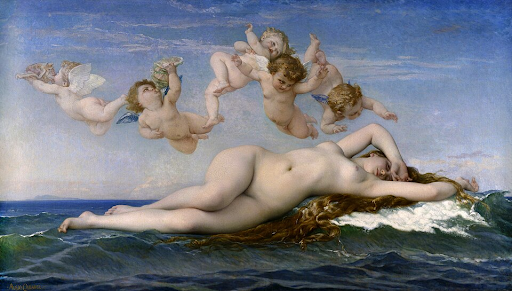
In 1855, Cabanel received the insignia of knight of the Legion of Honor for his contribution to French academic art. His most known painting, the Birth of Venus, was exhibited at the Salon of 1863 and purchased by Napoleon III for his private art collection. Following this, he received various portrait commissions from the French aristocracy, many of which were from Napoleon III.
Fig. 6. The Birth of Venus (La naissance de Vénus), by Alexandre Cabanel, 1863. Musée d’Orsay, Paris. https://www.musee-orsay.fr/.
From 1864 to his death, he passed on his expertise as a professor at the École des Beaux-Arts. He had hundreds of students and they were often displayed at the Salon and recipients of the Prix de Rome. He died on 23 January 1889 at the age of 65 in Paris, France.
Cabanel cemented himself as a proficient academic painter and one of the most influential teachers at the École des Beaux-Arts. He taught generations of artists, many of whom went on to become famous painters. Notable students include Jules Bastien-Lepage, Henri Gervex and Aristide Maillol. During his time as a juror for the Paris Salon, he often selected which pieces would be shown, often favouring traditional techniques. His paintings and teaching became an integral part of French culture and history.
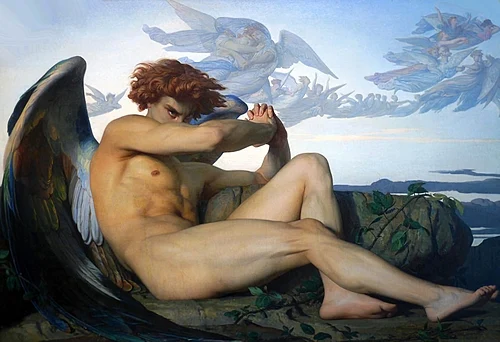
Fig. 7. The Fallen Angel (L’ange déchu), by Alexandre Cabanel, 1847. Musée Fabre, Montpellier. https://www.museefabre.fr/.
Paul Delaroche

Fig. 8. Self-Portrait [drawing], by Paul Delaroche, before 1848. Musée Hébert, Paris. Wikimedia Commons, https://commons.wikimedia.org/wiki/File:DelarochePortrait.
Paul Delaroche, born on July 17th, 1797, in Paris, France, was a French painter known for his paintings depicting historical scenes. He is most notably known for fusing the accuracy of Academicism and Neo-Classicism with the emotional storytelling of Romanticism.
He was born into a family of artists and art collectors, which encouraged him to attend the École des Beaux-Arts in Paris. He studied under the tutelage of Louis Etienne Watelet, a French landscape painter, but later left in 1817 due to his lack of interest in landscape paintings and the French academic system. Instead, he opted for the guidance under Antonie-Jean Gros. This point was a turning point in his young career as it allowed him to pursue his interest in historical painting.
Fig. 9. The Execution of Lady Jane Grey, by Paul Delaroche, 1833. National Gallery, London. https://www.nationalgallery.org.uk/paintings/paul-delaroche-the-execution-of-lady-jane-grey.

During the 1820s and 1830s, he exhibited several pieces at the Salon, with the Execution of Lady Jane Grey being his most acclaimed piece. It portrays Lady Jane Grey, the 'Nine Days’ Queen', who was the Queen of England for nine days from July 10 to July 19, 1553. However, she was later beheaded at the age of 17 due to her father’s involvement in a Protestant rebellion against Queen Mary I. Delaroche used historical sources in order to accurately depict the moments leading to her execution. During this time, he became known for historical paintings that often depicted tragedies.
Following his success in the French academic scene, he was commissioned to complete The Hemicycle, a 27 metre mural in the auditorium of the École des Beaux Arts. This piece was inspired by The School of Athens by Raphael and features seventy-five influential artists throughout the ages. The three thrones are seated by the creators of the Parthenon, the sculptor Phidias, the architect Ictinus and the painter, Appeles. Other figures include Raphael, Michelangelo and Poussin. Due to his talent and popularity, he was elected as a member of the Académie des Beaux-Arts in 1832 and became a professor at École des Beaux-Arts in 1833. Some of his notable pupils include Thomas Couture, Jean-Léone Gerome and Jean-François Millet.

Fig. 11. The Young Martyr, by Paul Delaroche, 1855. Musée du Louvre, Paris. La Jeune Martyre - Louvre site des collections.
These three artists are interwoven with their love for Academicism and their profound impact in French culture. They all began their journeys at the École des Beaux-Arts, which was the epicentre of the Academism movements. During their later careers, they all returned to the École as instructors, which only strengthened the academics' prestige as leaders in France’s cultural scene. They often passed down their teaching to their pupils, which only continued the domination of Academic art in Europe. Although they all received the same trainin, they all established their distinct styles through their careers. For example, Bouguereau and Cabanel both painted mythological scenes, but their approaches differed. Conversely, Delaroche combined the meticulousness of Academicism with his own interest in history. While they all developed their own styles, all three established themself as the pinnacle of Academic painting.
Works Cited
Bouguereau, William-Adolphe. Self-Portrait. 1879, Montreal Museum of Fine Arts, https://www.mbam.qc.ca/en/works/3176/. Accessed 24 Feb. 2026.
Bouguereau, William-Adolphe. Song of the Angels. 1881. WikiArt, https://www.wikiart.org/en/william-adolphe-bouguereau/song-of-the-angels-1881. Accessed 24 Feb. 2026.
Bouguereau, William-Adolphe. The Nut Gatherers. 1882. Wikimedia Commons, https://en.wikipedia.org/wiki/The_Nut_Gatherers#/media/File:William-Adolphe_Bouguereau_(1825-1905)_-_The_Nut_Gatherers_(1882).jpg. Accessed 24 Feb. 2026.
Cabanel, Alexandre. Self-Portrait. 1870. Musée Fabre, Montpellier. Google Arts & Culture, artsandculture.google.com/artwork/self-portrait-cabanel . Accessed 24 Feb. 2026.
Cabanel, Alexandre. The Birth of Venus (La naissance de Vénus). 1863. Musée d’Orsay, Paris. https://www.musee-orsay.fr/en/artworks/naissance-de-venus-98 Accessed 24 Feb. 2026.
Cabanel, Alexandre. The Fallen Angel (L’ange déchu). 1847. Musée Fabre, Montpellier. https://www.museefabre.fr/lange-dech. Accessed 24 Feb. 2026.
Delaroche, Paul. The Assassination of the Duke of Guise. 1834, Musée du Louvre, Paris. Wikimedia Commons, https://commons.wikimedia.org/wiki/File:Paul_Delaroche_-_L%E2%80%99assassinat_du_duc_de_Guise_au_ch%C3%A2teau_de_Blois_en_1588_-_Google_Art_Project.jpg/. Accessed 24 Feb. 2026.
Delaroche, Paul. Self-Portrait [drawing]. before 1848. Musée Hébert, Paris. Wikimedia Commons, https://commons.wikimedia.org/wiki/File:DelarochePortrait.jpg. Accessed 24 Feb. 2026.
Delaroche, Paul. The Execution of Lady Jane Grey. 1833, National Gallery, London. https://www.nationalgallery.org.uk/paintings/paul-delaroche-the-execution-of-lady-jane-grey. Accessed 24 Feb. 2026.
Delaroche, Paul. The Young Martyr. 1855, Musée du Louvre, Paris. https://collections.louvre.fr/en/ark:/53355/cl010066492. Accessed 24 Feb. 2026.
Hayes, Jeff. “Grisaille Underpainting Example.” Techniques of Painting: The Grisaille Underpainting, JeffHayes.com, https://www.jeffhayes.com/techniques-of-painting/the-grisaille-underpainting/. Accessed 24 Feb. 2026.


Comments